


Ecologically Sensitive Lighting Expert Guidance for Responsible Design
Well‑designed external lighting is essential for safe, functional spaces but without careful control it can severely disrupt nocturnal wildlife, particularly bats. The CBC team have specialist experience in mechanical and electrical engineering for sensitive environments, and can support clients to deliver compliant, high‑performance lighting schemes that also protect biodiversity.
Core Mitigation Principles
Effective ecological lighting mitigation is built on three foundations:
- Avoidance — Prevent light from reaching bat roosts, foraging areas, and commuting corridors. Maintaining a 20–30 m buffer around these features is one of the most effective interventions.
- Minimisation — Reduce intensity, duration, and spill through full cut‑off luminaires, lower mounting heights, and adaptive controls such as dimming, timers, and presence detection.
- Compensation — Where impacts cannot be fully avoided, maintain dark corridors or enhance alternative habitats to preserve ecological connectivity.
These principles guide every stage of design, from concept to commissioning.
Luminaire Performance
As part of a technical design support, our engineers specify luminaires with zero upward light output, tight beam control, and shielding to ensure illumination remains precisely where it is needed. Beam angles below 70° and additional spill baffles are often essential in sensitive zones.
Light Spectrum and Colour Temperature
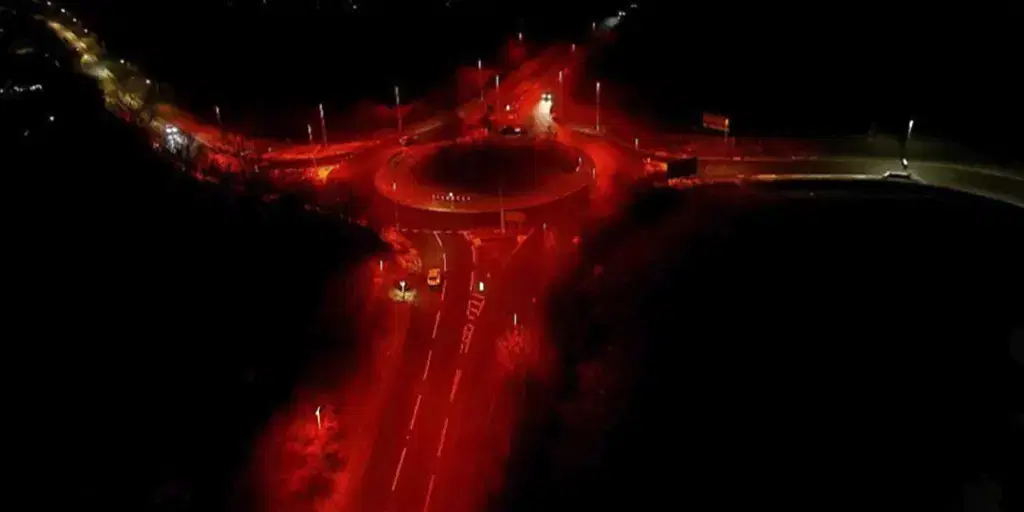
Lower colour temperatures (≤ 2700 K) significantly reduce ecological disturbance. In high‑sensitivity areas, narrow‑spectrum red lighting (630–660 nm) is proven to minimise behavioural impacts on bats and insects while maintaining essential visibility.
Intelligent Controls
Adaptive lighting, dimming schedules, part‑night operation, and sensor‑based activation reduces overall light levels and ensures illumination only when required. Zoning strategies allow us to tailor lighting to operational areas, transition zones, and ecological buffers.
Red Lighting for High‑Sensitivity Corridors
Red lighting is particularly effective along hedgerows, watercourses, and roost entrances. Installed at low heights with strong directional control, it supports bat movement with minimal disruption. Where human activity demands higher visibility, dual‑lighting systems can balance ecological protection with operational needs.
Understanding Bat Sensitivity
Bat species such as Myotis and Rhinolophus avoid even very low illumination (< 0.5 lux), making careful spatial design and spectrum selection essential. Our role includes working closely with project ecologists to ensure lighting strategies meet planning requirements and maintain habitat connectivity
Verification and Ongoing Performance
Post‑installation validation is critical. We undertake on‑site lux and spectrum measurements—particularly important for narrow‑band red sources—and support ongoing ecological monitoring. This allows fine‑tuning of controls and shielding to maintain long‑term effectiveness.
Responsible lighting design in ecologically sensitive areas requires technical precision and ecological understanding. By integrating avoidance, minimisation, and compensation strategies with advanced luminaire selection and adaptive controls, we help clients achieve compliant, high‑quality lighting that safeguards nocturnal biodiversity.
Our team of mechanical and electrical engineers collaborate with clients from the inception of a design all the way through to build. It is this effective collaboration and involvement in projects from the start that enables us to advise clients and help them achieve their aspirations ensuring lighting is not just functional, but ecologically sound and compliant.
Please contact the team if you wish to discuss a project that requires lighting design.